
Winter in Southern Oregon doesn’t always arrive with a dramatic announcement. Sometimes it’s a week of rain that never seems to stop. Sometimes it’s a sudden overnight freeze that turns sidewalks into ice and makes even the simplest routines feel impossible. For many of us, winter means warm coats, hot meals, and heading home at the end of the day. But for people living without stable housing, winter is a season of constant problem-solving—and for the pets who stay faithfully by their side, the challenges can be just as serious. That’s why winter support for unhoused pets matters. Not as a trend, not as a one-time donation during the holidays, but as a real and ongoing commitment from caring communities who believe every animal deserves safety, comfort, and basic care—even when life is hard.
 Pets on the street face real winter risks
When temperatures drop and storms roll in, animals living outdoors face immediate threats: exposure, wet fur that won’t dry, cold paws on pavement, and the risk of hypothermia. Even in Southern Oregon, where winter weather can vary, damp conditions alone can be dangerous. Rain-soaked bedding, muddy camps, and wind that cuts through thin blankets can quickly become a health crisis for a dog or cat.
Cold weather also makes existing medical issues worse. Arthritis becomes more painful. Minor cuts can turn into infections. Skin conditions can flare up. And if a pet isn’t eating consistently, their body has less fuel to stay warm. For animals already living in survival mode, winter can be the season where small problems become emergencies.
The people who love them are doing their best
One of the most overlooked truths about pets belonging to unhoused individuals is this: these animals are deeply loved. Many people living on the street prioritize their pet’s needs even when their own are unmet. They share food. They give up warmth. They walk miles to find help. Their pets provide protection, companionship, emotional grounding, and a reason to keep going.
But love doesn’t create access to veterinary care. Love doesn’t make spay and neuter surgery affordable. Love doesn’t prevent accidental litters or stop a preventable illness from spreading. This is where the community can make a difference—with practical help that respects both the pet and the person.
Keeping Gigi Warm this Winter
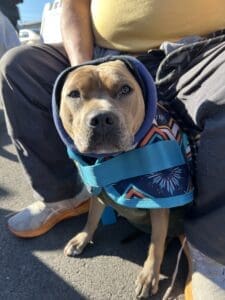
Gigi is one of the many dogs who have needed extra help this winter.
We’ve been working with Gigi and her companion, Michael, since she was a tiny puppy and they were staying at a converted hotel operated by ACCESS. Michael first reached out to us for help with food, vaccines, parasite prevention, and some early medical concerns. With a little support, Gigi thrived. When she was old enough, we transported her to the vet and paid for her spay surgery.
Unfortunately, Michael and Gigi are now back on the streets. On a recent cold night, Michael contacted us because he urgently needed food and a coat for Gigi. A friend let them sleep in a car that night, and the next morning they came to our outreach event, where we provided food and fit Gigi with a warm, waterproof coat.
Michael has even created a special covering for Gigi’s sensitive ears — which she’s proudly modeling in the photo below.
Gigi means the world to Michael, and she is completely devoted to him. Michael lives with severe COPD and is working toward placement in a housing program in Grants Pass. Through it all, Gigi is his constant companion — and his reason not to give up.
Spay and neuter services are a powerful form of winter support
When we think of winter support for unhoused pets, we often picture blankets, dog coats, or food donations. Those are important. But spay and neuter services may be one of the most impactful forms of support a community can offer.
Spay and neuter procedures help prevent future litters that would otherwise be born into unstable, high-risk environments. They reduce the number of animals vulnerable to exposure, hunger, and illness. They also help improve long-term health outcomes for pets and can reduce behaviors that put animals at risk, such as roaming.
For nonprofits offering free or discounted spay and neuter services, community support isn’t just appreciated—it’s essential. Every donation, every volunteer hour, every shared post helps keep those services available for the pets who need them most.
How Southern Oregon communities can help right now
If you’re someone who cares, you may be wondering what you can do that actually helps. The good news is that meaningful support doesn’t require perfection—it requires participation. Here are several ways individuals can step up this winter:
1. Donate pet essentials that truly make a difference
Warm, waterproof items are especially valuable in winter: durable blankets, towels, tarps, insulated pet beds, leashes, collars, and pet-safe rain gear. Sealed bags of dog and cat food are always needed, too.
2. Support spay and neuter programs financially
Even small donations help cover surgical costs, medications, transport, and follow-up care. A single procedure can prevent multiple animals from ending up in crisis later.
3. Volunteer your time or skills
Many nonprofits need help with outreach, transportation coordination, supply organization, and event support. If you have time, you have something valuable to offer.
4. Share resources without judgment
Sometimes the simplest help is connection. If you know of local services offering veterinary care, supplies, or assistance, share them kindly. Respect matters. Dignity matters.
5. Be the person who notices—and cares
If you see someone with a pet outside in winter weather, a warm conversation can make a difference. Not everyone wants help, but everyone deserves to be treated like a human being.
Compassion is a community value, not a personal hobby
Southern Oregon has always had people who look out for one another. Neighbors helping neighbors. Small acts that quietly change someone’s week. Supporting pets of the unhoused is part of that same spirit. It’s not about politics. It’s not about judgment. It’s about recognizing that animals shouldn’t suffer because humans are struggling—and that caring people can help bridge the gap.
This winter, let’s make winter support for unhoused pets more than a phrase. Let’s make it a community standard. And if you’re looking for a direct way to help locally, consider supporting Rogue Valley Street Dogs through donations or supplies—your contribution helps keep vital services available for the pets who need them most. When we protect the most vulnerable animals among us, we strengthen the values that make Southern Oregon a place worth calling home.
Reader Interactions